
By Jeff Glass, Lead Compliance Consultant · HMO KIT · Last verified 18 September 2026
Tower Hamlets selective licensing ends on 30 September 2026: what landlords need to know
If the property currently needs a licence, applying before the scheme closes still matters — waiting until 1 October does not fix earlier non-compliance.
Do you own or manage a rental property in Whitechapel, Weavers or Banglatown & Spitalfields? Are you wondering whether it is still worth applying for a selective licence when the current Tower Hamlets scheme is about to finish?
The short answer is yes, if the property currently needs a licence.
Tower Hamlets’ selective licensing scheme ends on 30 September 2026. From 1 October, there will be no selective licensing scheme operating in the borough under the current designation (Tower Hamlets selective licensing).
However, landlords shouldn’t confuse the scheme ending with the existing licensing requirement disappearing early.
Tower Hamlets Council specifically says that landlords and agents of properties that were licensable before the end of the scheme should act now and make an application. No new selective licence or Temporary Exemption Notice applications can be made after 30 September 2026.
In other words, waiting until 1 October isn’t a way of fixing a property that should already have been licensed.
This guide explains what the deadline means, why applying before the scheme closes can still matter, and the potential consequences of leaving a licensable property unlicensed.
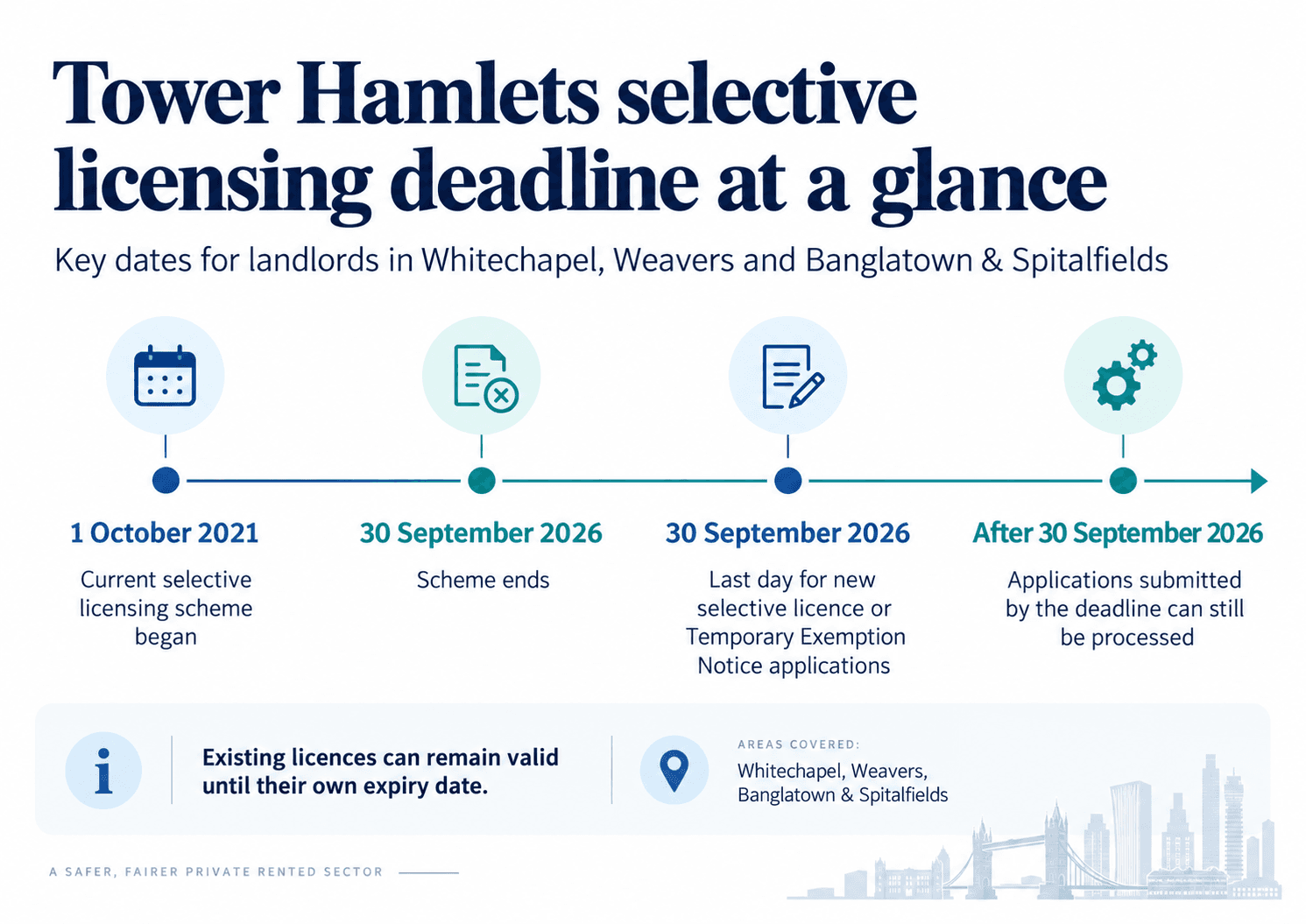
Tower Hamlets selective licensing deadline at a glance
| Topic | Position |
|---|---|
| Current scheme ends | 30 September 2026 |
| Last day for new applications | 30 September 2026 |
| From 1 October 2026 | No selective licensing scheme under the current designation |
| Areas covered | Weavers, Whitechapel and Banglatown & Spitalfields |
| Applications submitted before the deadline | Tower Hamlets will continue processing them |
| Existing licences | Can remain in force after the scheme ends |
| Selective licence fee (registry) | £897 |
| Maximum financial penalty | Up to £40,000 |
| Rent Repayment Orders | Up to 24 months’ rent under post-1 May 2026 rules |
When exactly does the Tower Hamlets selective licensing scheme end?
The current scheme began on 1 October 2021 and runs for five years, ending on 30 September 2026.
It covers privately rented properties within the designated parts of Weavers, Whitechapel and Banglatown & Spitalfields. Broadly, selective licensing applies to privately rented properties occupied by one household or certain properties occupied by no more than two people forming two households. HMOs fall under separate mandatory or additional licensing rules.
The important date for landlords is 30 September 2026.
Tower Hamlets says that new applications for both selective licences and Temporary Exemption Notices close after that date. From 1 October, landlords will no longer be able to make a new application under this particular scheme.
What if I’m not sure whether my property is in the licensing area?
Don’t rely solely on the neighbourhood name.
Licensing boundaries can be surprisingly easy to get wrong, particularly where properties sit close to ward boundaries.
Tower Hamlets provides an online map where landlords can enter the property postcode. Properties displayed within the designated green area require selective licensing, subject to the usual exemptions (council selective licensing page).
If there is any doubt, check the individual property rather than assuming it falls inside or outside the scheme.
Why apply if the scheme is about to finish?
This is the obvious question.
If the licensing scheme disappears on 1 October, why go through the application process during its final days?
Because the property still needs to comply with the law while the scheme remains in force.
Tower Hamlets’ own advice is clear. If you are the landlord or agent of a property that was licensable before the scheme ends, the council says you should act now and apply. It will continue processing applications received before the deadline even after the designation itself has finished.
There is also an important distinction between applying late and not applying at all.
Making an application now does not magically erase an earlier period when the property should have been licensed. However, government guidance on Rent Repayment Orders confirms that a landlord has a complete defence to the failure-to-license offence from the date a valid licence application is made while that application remains effective. The period before the application may still be relevant (GOV.UK RRO guidance).
Consequently, putting the application off simply because the scheme is approaching its end can create unnecessary additional risk.
What happens if a Tower Hamlets property should be licensed but isn’t?
Unfortunately, property licensing isn’t an area where landlords can safely take a “the scheme is nearly finished anyway” approach.
Tower Hamlets says that operating a property without a licence when it should have one is an offence.
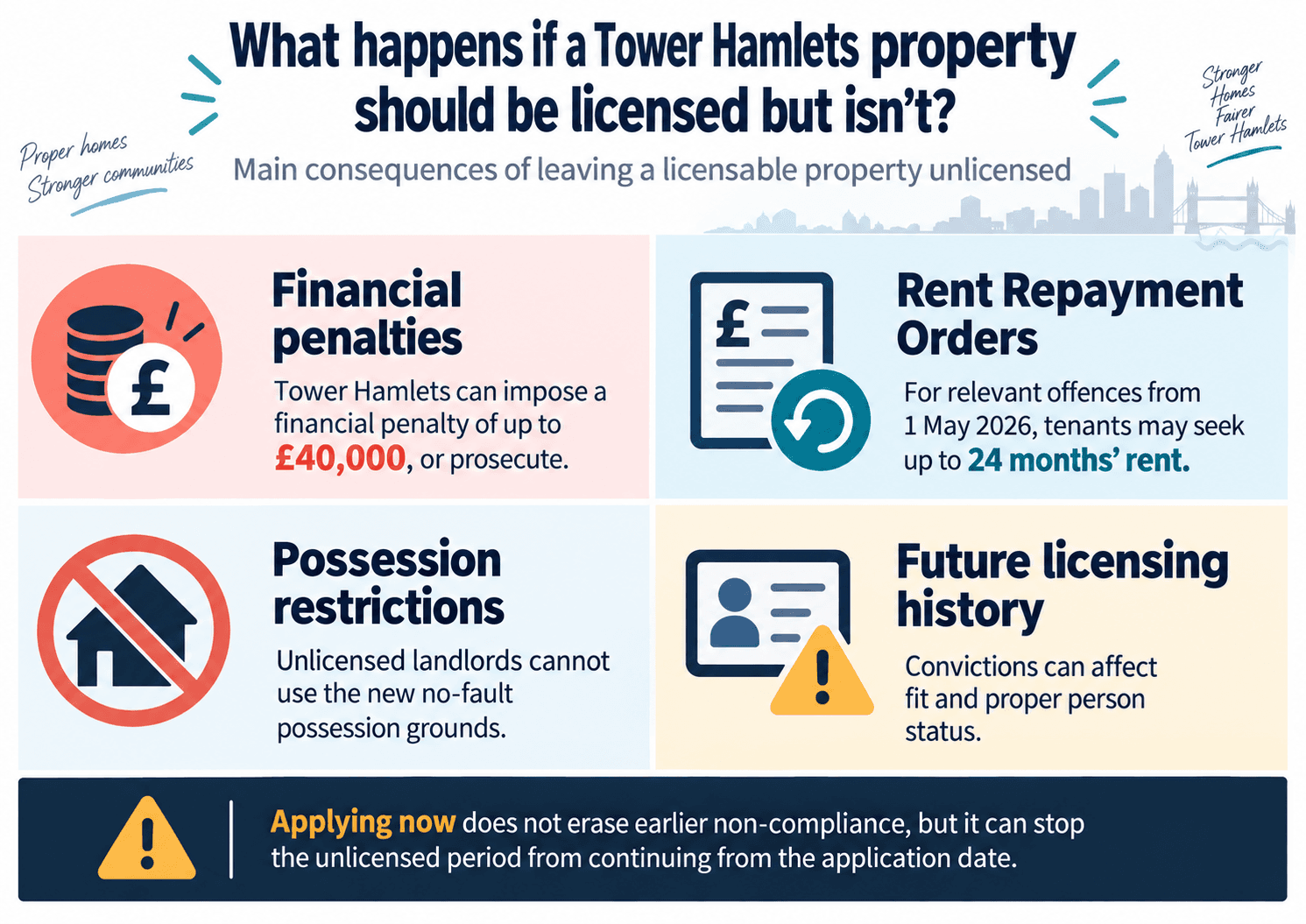
The consequences may include prosecution and an unlimited fine, or a financial penalty of up to £40,000.
That £40,000 figure is a maximum rather than an automatic penalty. What actually happens will depend on the circumstances of the case and the council’s enforcement process.
However, the financial penalty isn’t the only issue. An unlicensed landlord may also face a Rent Repayment Order, restrictions on certain possession grounds and, where there is a conviction, possible consequences for their future “fit and proper person” status.
Can tenants claim rent back if the property isn’t licensed?
Potentially, yes.
Failure to obtain a required selective licence is one of the offences that can lead to a Rent Repayment Order (RRO).
The rules changed on 1 May 2026 when provisions of the Renters’ Rights Act 2025 came into force.
For qualifying offences committed from 1 May 2026, the maximum period can now be up to 24 months’ rent (two years). Offences committed entirely before 1 May 2026 remain subject to the previous rules, including the former one-year maximum. Where an ongoing offence spans both periods, different rules may apply to each part.
This distinction matters for Tower Hamlets landlords because the final months of the selective licensing scheme fall under the newer RRO regime.
Does applying for a licence stop an RRO?
Not retrospectively.
Government guidance says that where a landlord applies for the required licence, they have a complete defence to the failure-to-license offence from the application date. A tenant may still be able to seek an RRO in respect of an earlier period during which the property was unlawfully unlicensed.
So an application isn’t an eraser. But there is an obvious difference between addressing the licensing problem now and allowing an unlicensed period to continue until 30 September.
Does licensing still affect possession?
This part of landlord law changed substantially in 2026.
Older articles often linked unlicensed properties to historic Section 21 consequences. For private rented properties in England, that regime was abolished from 1 May 2026.
Landlords now generally need to rely on the revised Section 8 possession grounds and follow the new possession process.
That doesn’t mean licensing has become irrelevant to possession proceedings.
Tower Hamlets states that landlords of unlicensed properties cannot use the new no-fault possession grounds introduced under the Renters’ Rights Act 2025.
If you’re planning possession proceedings and there is any doubt about the licensing position, obtain advice on the particular tenancy and property rather than relying on outdated online summaries.
Does a previous licensing offence affect future licences?
It can.
One of the things councils consider when granting certain property licences is whether the proposed licence holder or manager satisfies the “fit and proper person” requirements.
Tower Hamlets says that convictions relating to unlicensed properties can affect a person’s fit and proper person status and may consequently limit their ability to manage licensable properties in future.
That doesn’t mean every late application automatically causes a future licensing problem. These matters depend on the circumstances. It is another reason why landlords shouldn’t regard the end of the current designation as making past compliance irrelevant.
What happens to existing Tower Hamlets selective licences after 30 September?
This is another area where it’s easy to misunderstand the scheme ending.
Your existing licence does not necessarily expire on 30 September 2026.
Tower Hamlets says that, unless issued for a shorter period, a selective licence can remain valid for five years. Existing licences and applications submitted before the deadline will continue to be administered after the scheme itself closes.
Landlords must also continue complying with their licence conditions until the individual licence expires, and the council says inspections of licensed properties will continue.
For example, imagine a landlord whose licence remains valid beyond September 2026. The fact that new applications have closed doesn’t mean that landlord can ignore the conditions printed on their existing licence from 1 October.
What if my licence is about to expire?
Check the expiry date rather than assuming it runs until the scheme closes.
Tower Hamlets advises current licence holders to check their licence and, where a renewal is required before the scheme ends, apply in advance. A new application is also required if the licence holder has changed.
If the position is unclear because the licence expires around the September deadline, contact the council’s housing licensing team (housinglicensing@towerhamlets.gov.uk, 020 7364 5008) rather than making assumptions.
Will Tower Hamlets introduce another selective licensing scheme?
Possibly, but there isn’t a replacement selective licensing scheme in force from 1 October 2026.
Tower Hamlets says that it is considering options for a future scheme and has commissioned modelling of the borough’s private rented housing stock. That work is expected to become available in October 2026.
The council’s 2026–2036 Housing Strategy also refers to using licensing to improve standards across more than 12,600 homes (Housing Strategy 2026–2036).
So the current designation is definitely ending. What shouldn’t be assumed is that selective licensing in Tower Hamlets has disappeared forever. Landlords with properties in the borough will need to keep an eye on what happens next.
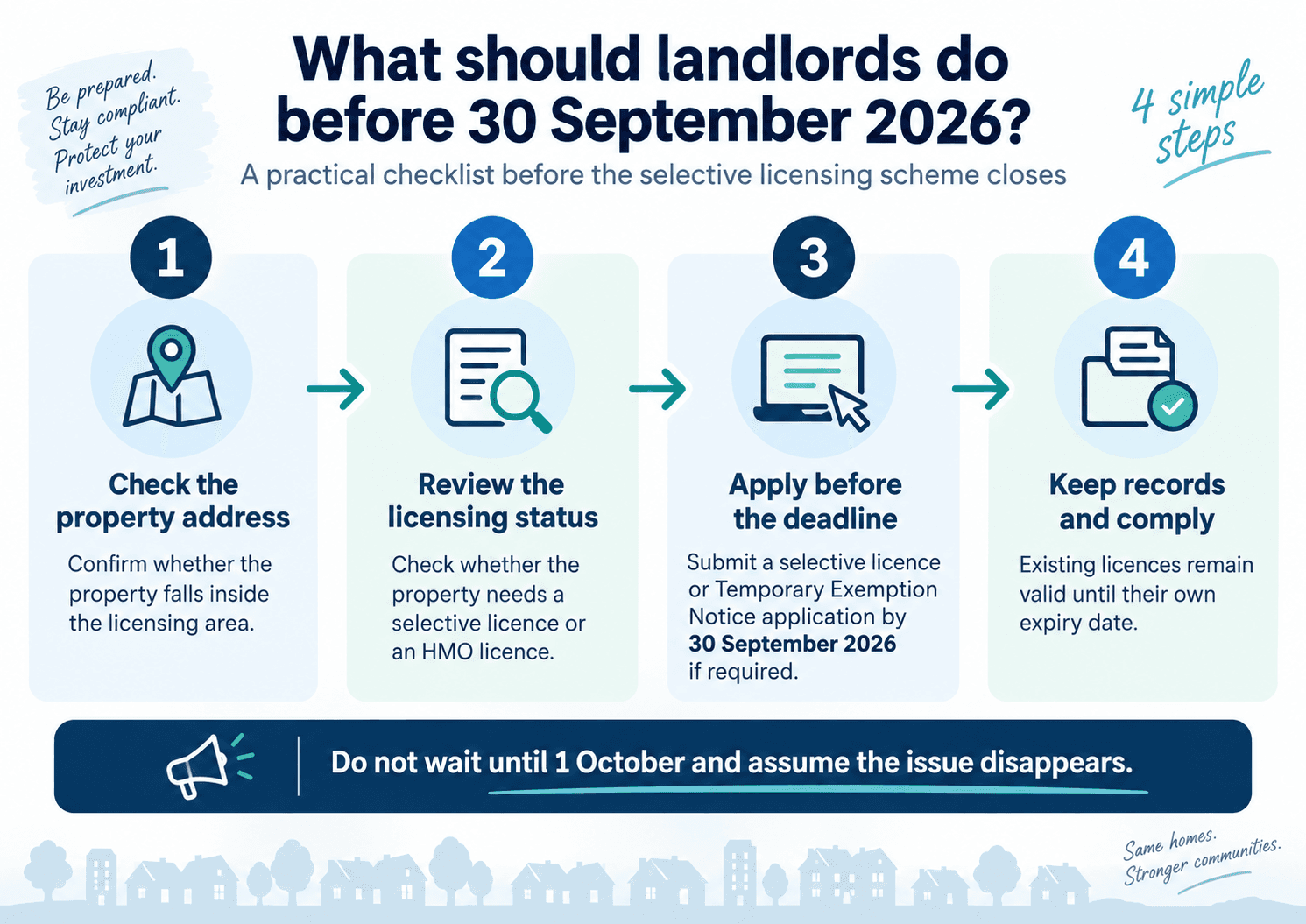
What should landlords do before 30 September 2026?
If you own or manage a privately rented property within the existing selective licensing area, the sensible starting point is to establish its exact licensing status.
In practical terms:
- Check the property address against Tower Hamlets’ selective licensing map.
- Check whether an existing licence is still valid and who the named licence holder is.
- Establish whether the property instead falls within HMO licensing — see Do I need an HMO licence?.
- If a selective licence or Temporary Exemption Notice is required, make the appropriate application no later than 30 September 2026.
- If there has already been a period without a required licence, consider taking specialist advice about the potential enforcement and RRO consequences.
The main point is not to wait for 1 October in the hope that an existing problem simply disappears.
It won’t necessarily do that.
Tower Hamlets selective licensing FAQs
Does selective licensing end in Tower Hamlets on 30 September 2026?
Yes. The existing Tower Hamlets selective licensing designation ends on 30 September 2026. There will be no selective licensing scheme operating under the current designation from 1 October 2026.
Can I submit a new selective licence application after 30 September?
No. Tower Hamlets says no new selective licence or Temporary Exemption Notice applications can be made after 30 September 2026.
Do I really need to apply if the scheme only has a short time left?
If your property currently requires a selective licence, Tower Hamlets says landlords and agents should act now and apply before the scheme ends. The council will continue processing applications that were submitted by the deadline.
Does applying now protect me from an earlier unlicensed period?
Not necessarily. Government guidance says a landlord has a defence to the failure-to-license offence from the date a valid licence application is made. That does not automatically remove liability relating to the period before the application.
How much can Tower Hamlets fine a landlord for an unlicensed property?
Tower Hamlets says operating a property without a licence where one is required can result in prosecution and an unlimited fine, or a financial penalty of up to £40,000.
Can a tenant claim 24 months’ rent?
For qualifying Rent Repayment Order offences committed from 1 May 2026, the maximum has increased to up to 24 months’ rent (two years). Earlier offences are subject to the previous rules, and transitional provisions apply where an offence spans both regimes.
Does my existing licence end automatically on 30 September 2026?
No. Existing licences can continue after the scheme closes. Licence holders remain responsible for complying with their licence conditions until their particular licence expires.
How much is a Tower Hamlets selective licence?
The council’s published selective licence fee in HMO KIT’s registry is currently £897. Confirm the current schedule on the Tower Hamlets fees page before applying.
Final thoughts
The end of Tower Hamlets’ selective licensing scheme is good news for landlords who will no longer need a new selective licence under the current designation from 1 October 2026.
However, the deadline creates a potential trap for landlords whose properties already should be licensed.
The council isn’t saying, “there are only a few days left, so don’t worry about it”. It is saying the opposite: landlords of properties that were licensable before the scheme ends should act now.
If you’re already compliant, check your licence expiry date and continue meeting its conditions.
If you’re unsure whether your property needs a licence, check the address.
And if the property should already have one, don’t assume 1 October will make the earlier licensing issue disappear.
The deadline for new applications is 30 September 2026.
Useful links
Last updated: September 2026. This guide provides general information for landlords and is not legal advice. Licensing and enforcement outcomes depend on the individual property and circumstances. Always check the current Tower Hamlets designation, fees and guidance for the address concerned.
Check the address first
Use the free licence checker for Tower Hamlets, then verify borderline properties on the council map.